Business ownership / Original-text edition
Are You Building a Hero Business or a Performer Business?
The difference is invisible to your customers. But they feel it every time.
By Dennis Willis · Original published
B reading layout ·
The original essay’s words, including its comparisons and conclusions. These are the author’s published views, not a personalized assessment or a newly verified research review. This is writing about work and companies, not parenting advice.
There are two ways to run a business: You can be a Strip Miner or a Farmer.
The Strip Miner (Performer) extracts maximum cash from customers and employees as fast as possible before moving on.
The Farmer (Hero) tends the soil, knowing that healthy employees and happy customers yield fruit for decades.
Are you building an asset, or are you just running a harvest?
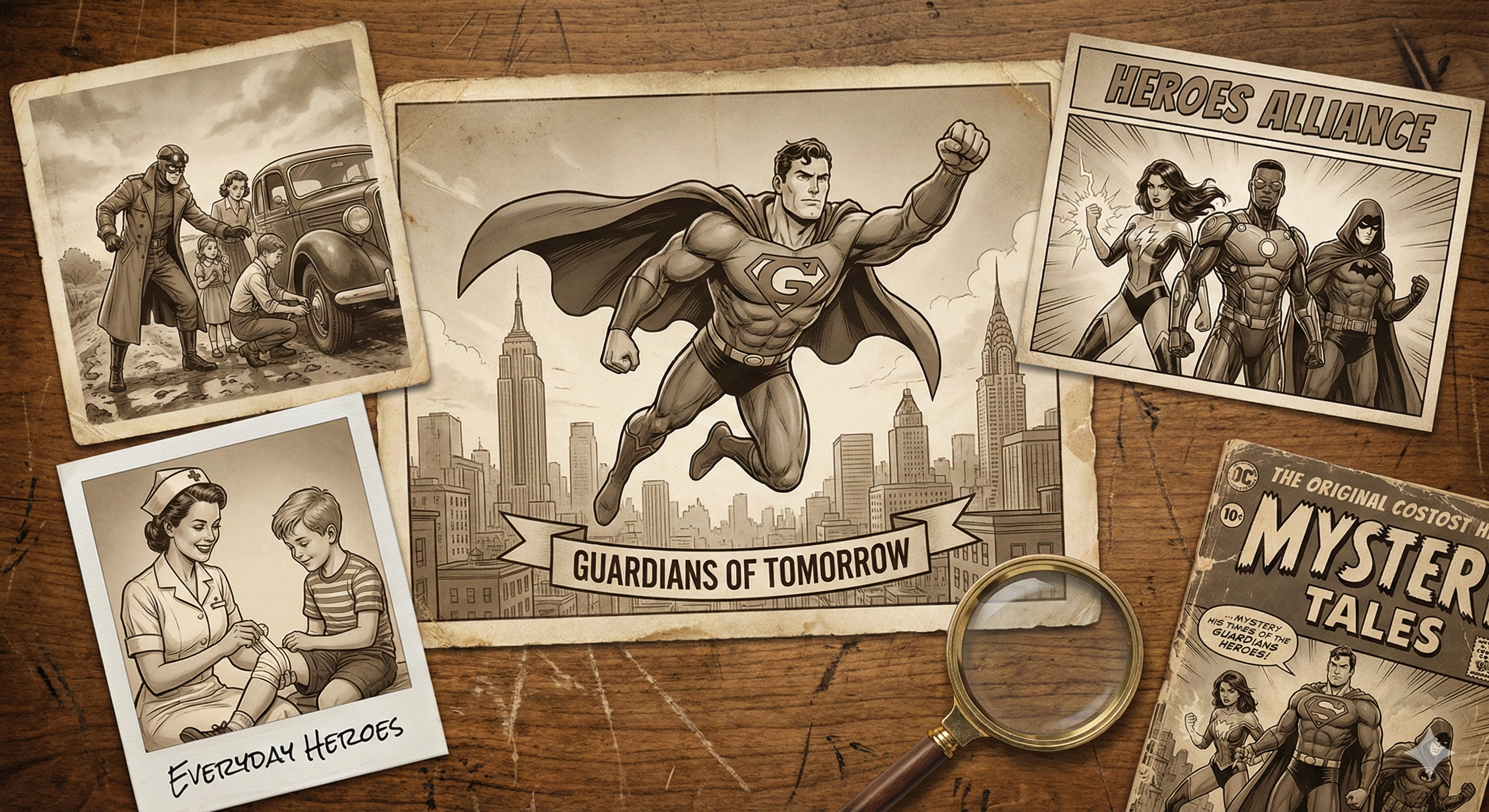
Read the illustration
Separate reading aid: a sepia montage of photographs and comic panels on a wooden tabletop. In the center, a caped superhero with a “G” emblem flies above a city beneath the banner “GUARDIANS OF TOMORROW.”
At upper left, a goggled figure stands beside a family and someone repairing a car wheel. Below, a nurse bandages a child’s knee; the caption reads “EVERYDAY HEROES.” At upper right, three costumed figures appear beneath “HEROES ALLIANCE.”
A magnifying glass rests beside a partly cropped comic book at lower right. Some small decorative lettering is unclear or cropped and is not transcribed here.
A woman walked into an auto repair shop in Novato, California, worried about her brakes.
Another mechanic had quoted her a big number. She came to Steve Lite at Steve's Auto Care for a second opinion.
Steve looked at her brakes. Then he significantly reduced the estimate. Not because she negotiated. Not because she complained. Because her brakes didn't need what the other shop wanted to sell her.
When asked about his approach, Steve's answer was simple: "How can I save people money? Do the repair a little bit differently."
His customer Christine later said: "He was very honest and did not overcharge. He was very honest with what services we actually needed but also what you could do."
Steve treats every car like it belongs to family. He could upsell. He could pad estimates. Every business consultant would tell him he's leaving money on the table. Instead, he builds customers for life—some families now spanning three generations.
That's the difference between a Hero Business and a Performer Business.
The Two Types of Businesses
A Hero Business's mind is filled with thoughts of you.
A Performer Business's mind is filled with thoughts of themselves.
If you're building a business and you're worried about how you look to investors, or calculating how your decisions will affect your valuation, or optimizing for metrics that serve your exit—your mind is filled with you. You're building a performer.
If, on the other hand, your mind is filled with the people you serve—watching them, listening to them, figuring out how to genuinely help them—then you're building a hero.
Why It's Confusing
Here is the tricky part: Both types can succeed. Performer businesses can scale faster. They can optimize better. They can appear more "professional."
The performance often works. Until it doesn't.
Steve isn't alone. A mechanic shared his story on Reddit: An older woman came in, upset, barely speaking English. Another shop had scared her into thinking she needed to sell her car. He inspected it and told her the truth—her car was fine. He didn't charge her a dime. She cried and hugged him.
Word of mouth is how 87% of small businesses get new customers. Steve doesn't advertise. Neither does that mechanic. Their reputation does the work.
There's a reason some businesses have customers who feel like evangelists while others have customers who feel like hostages.
"People will forget what you said, people will forget what you did, but people will never forget how you made them feel." — Maya Angelou
Your customers can't articulate the difference. They just feel it. And they vote with their wallets, their referrals, and their loyalty.
The Diagnostic
How do you know which one you're building? Not by your mission statement. Not by your values page. By what happens in the moment of decision.
| Hero Business | Performer Business |
|---|---|
| Optimizes pricing for customer value | Optimizes pricing for what market will bear |
| Content helps people (whether they buy or not) | Content exists to generate leads |
| Owns mistakes publicly and fixes them fast | Minimizes mistakes and protects reputation |
| Celebrates when customers outgrow you | Designs lock-in and switching costs |
| Would share real metrics with customers | Guards information as competitive advantage |
The Math No One Talks About
Here's what business school doesn't teach: Hero businesses often win the long game.
Customer acquisition cost for a referral: nearly zero. Customer lifetime value when they trust you: nearly infinite. Marketing spend when your customers are your sales team: optional.
Steve's "lost" revenue on that brake job? It bought him a customer for life. That customer tells her friends. Her friends tell their friends. Three generations of one family now bring their cars to Steve.
The mechanic who didn't charge the elderly woman? That story went viral. Thousands of people now know his shop is honest. He couldn't buy that kind of marketing.
Performers spend fortunes acquiring customers they'll eventually lose. Heroes spend nothing keeping customers who'll never leave.
The Performer Trap
The hardest part is that performer behavior often comes from good intentions corrupted by bad incentives.
You start with "I want to help people." Then you need to make payroll. Then investors want growth metrics. Then you're optimizing for numbers instead of humans. Then you wake up one day running a business you don't recognize.
The performer isn't evil. The performer is just lost.
The Mirror
This is the part that keeps founders up at night.
Every business decision reveals which type you're building. Every pricing choice. Every policy. Every moment you choose between what's easy for you and what's right for them.
Your customers aren't just evaluating your product. They're evaluating your character. And they know. They always know.
Heroes want this feedback. They seek out the uncomfortable truth because they'd rather know than pretend.
Performers will close this tab right now.
Which one are you?
Every business either serves its customers or performs service for them.
Which one are you building?
About this edition.
The complete original essay remains in order. Reading tools and neutral links to the original offers are separate from the authored text.
This preserves the author’s original argument and illustration. Reading this page does not score your business or leadership, submit answers or validate the essay’s research claims.
Read Dennis Willis’s original article — original design, at Harmonic Way ↗
Keep exploring.
Explore Hero or Performer Business — original design, at Harmonic Way ↗
Explore Isn’t the Acting Exhausting? — original design, at Harmonic Way ↗
Review the questionnaire and any book offer on their own pages. This reading page does not submit answers or make a purchase.
Share this page without personal details. Open clean page link. You can also use your browser’s Print command.