Work & leadership / Original-text edition
Are You a Hero or a Performer?
By Dennis Willis · Original published
B reading layout ·
The original essay’s words, including its comparisons and conclusions. These are the author’s published views, not a personalized assessment or a newly verified research review. This is writing about work and companies, not parenting advice.
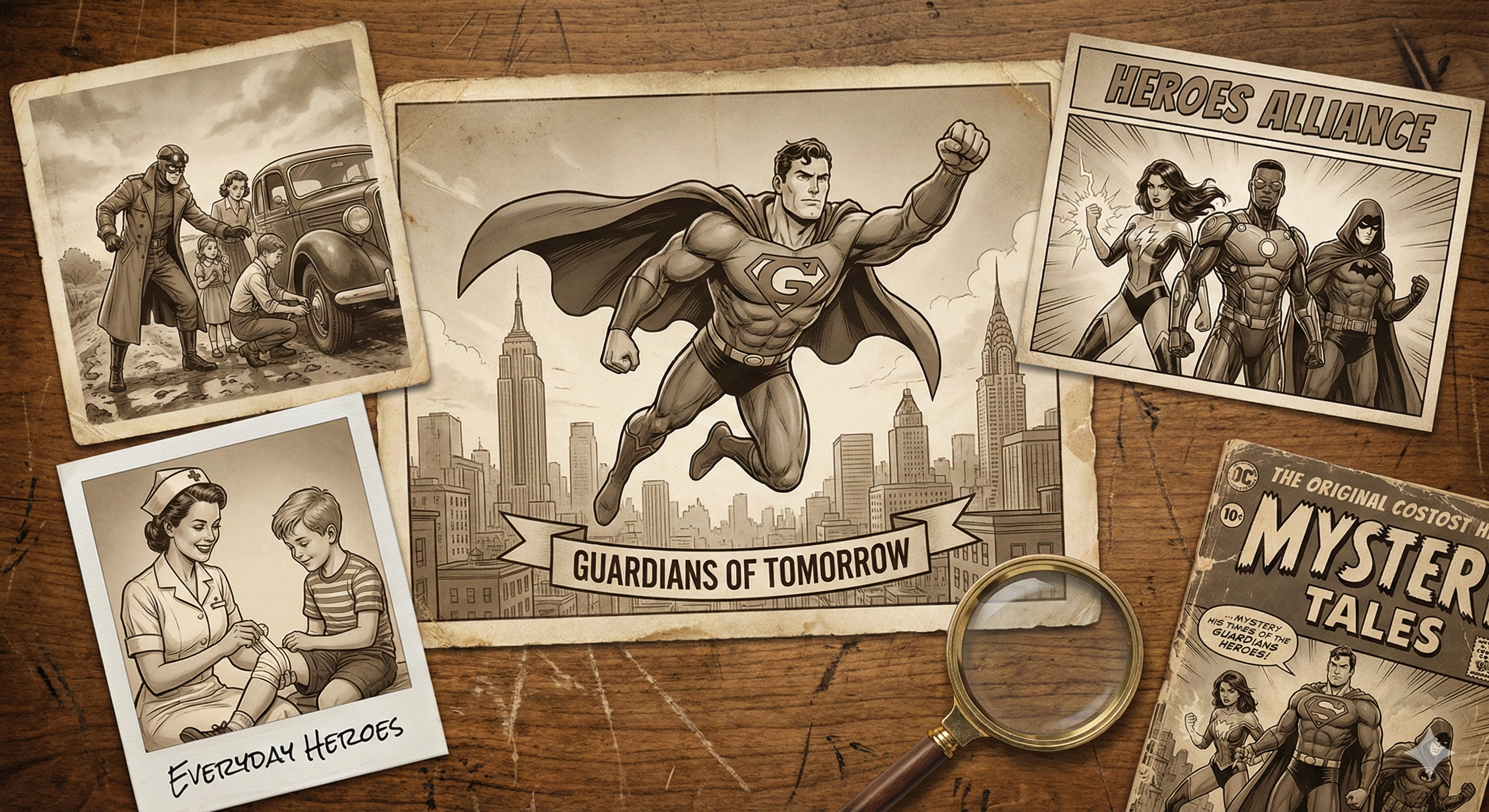
Read the illustration
Separate reading aid: a sepia montage of photographs and comic panels on a wooden tabletop. In the center, a caped superhero with a “G” emblem flies above a city beneath the banner “GUARDIANS OF TOMORROW.”
At upper left, a goggled figure stands beside a family and someone repairing a car wheel. Below, a nurse bandages a child’s knee; the caption reads “EVERYDAY HEROES.” At upper right, three costumed figures appear beneath “HEROES ALLIANCE.”
A magnifying glass rests beside a partly cropped comic book at lower right. Some small decorative lettering is unclear or cropped and is not transcribed here.
I loved superheroes as a kid. I think I love them even more now. But in the modern workplace, we have confused Heroes with Performers.
And that confusion is why you are so tired.
We are in the middle of an epidemic of exhaustion. We call it "burnout," but that implies your battery is broken. It isn't. In many cases, you are simply being drained by a leadership style that views you as a crop rather than a colleague.
To understand why you are exhausted, you have to understand the two systems operating in every workplace: The Hero (who builds) and The Performer (who extracts).
The Difference is in the Mind
The difference is simple, yet most of us are unaware of it:
A Hero's mind is filled with thoughts of you.
A Performer's mind is filled with thoughts of themselves.
If you are a leader and you are worried about how you look to upper management, or if you are calculating how your actions will reflect on your year-end review—your mind is filled with you. You are a Performer.
If, on the other hand, a leader's mind is filled with the people they lead—watching them, listening to them, figuring out how to help them succeed—then you have a Hero.
The "Performance" Trap
Fifty years ago, W. Edwards Deming, the father of the quality movement, asked a terrifying question: "What happens when management sees their responsibility as an act?"
You get actors. You get a business that is fiction.
A Hero may watch somebody all day and not say a thing because they can find no way to help them. A Performer will suspect they aren't doing their job if they aren't in there doing "visible leadership." They interfere, they demand updates, and they create friction just to prove they exist.
From Predation to Harvesting
This performative instinct plays into our base instincts. It turns us into predators. The mindset becomes: "I have to look good, and it's okay if I end up doing it at your expense."
We have succeeded in making a world where we no longer need to be predatory, yet the instinct remains. Performers continue to harvest their teams—extracting energy, credit, and time like a strip-mining operation—selling leadership that offers no value other than to the seller.
The System Makes the Performer
I've read that humans are wired to adopt the moral system of the community we are in. We take 75% of our values from what we see ourselves as a part of.
If you are in a performative environment trying to be an actual hero, you might get run out. You will make the performers feel bad at a deep level because you aren't playing the game. You are the person running into the burning building to help somebody, while they are the person acting out a recreation—but stopping short because the fire might actually hurt.
Which One Are You?
Now is the time for heroes. But you cannot be a hero if you are being harvested.
You need to know what system is shaping you. Is your boss building you, or are they extracting from you?
About this edition.
The complete original essay remains in order. Reading tools and neutral links to the original offers are separate from the authored text.
This preserves the author’s original argument and illustration. Reading this page does not score your business or leadership, submit answers or validate the essay’s research claims.
Read Dennis Willis’s original article — original design, at Harmonic Way ↗
Keep exploring.
Explore Hero or Performer Boss — original design, at Harmonic Way ↗
Explore Isn’t the Acting Exhausting? — original design, at Harmonic Way ↗
Review the questionnaire and any book offer on their own pages. This reading page does not submit answers or make a purchase.
Share this page without personal details. Open clean page link. You can also use your browser’s Print command.